
Modeling Corn Fields
Text and Photos, Mike Skibbe

Close-up of broom straw corn in N Scale
Nothing says "Midwestern Railroading" like a nice field of corn. Several methods have been popularized over the years. The first convincing corn I saw was made with an indoor-outdoor plastic carpeting material. It was quick and dirty, allowing one to plant a field in no time at all. But, there was no real detail, and much imagination had to be added. More recently, a few companies have brought out photo-etched sheets of corn that can be twisted into 3-D plants, painted, and planted. While time-consuming, the detail is fantastic. The major downside is cost, as large fields get really pricey.
There's an old adage among amateur racers that applies here: Fast, Cheap, and Reliable... You can only pick two. In our case, we have Detailed, Cheap, and Easy. The indoor-outdoor carpeting is cheap and easy, but not detailed. The photo-etched corn is easy and detailed, but not cheap. So, we need a method that is cheap and detailed. And while you can argue that this method is "easy", the real problem is that it's time consuming!
We're going to use old fashioned broom straw for this N scale cornfield. The broom was obtained at a craft store during Halloween closeout, and cost about $0.99. Notice that the natural ends of the straw are intact on the broom. The branches give the effect of wilting corn leaves when packed in a field.
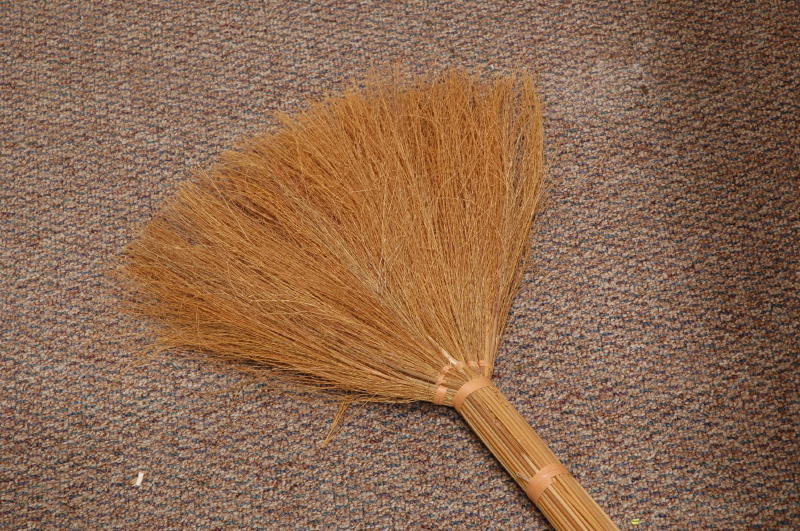
Old fashioned or natural straw broom, sometimes sold as a "Witch's Broom" around Halloween
First, prepare the field itself. You are going to want to use a foam insulation base, and glue some dirt down on the filed before planting the corn. I used some flat black latex paint and sprinkled in Woodland Scenics Soil while the paint was still wet. Once dry, the excess was brushed off and I have a dirt field ready for corn.
The natural straw color is a perfect match for the late September dried corn in my area. The corn dries out in late summer even before the trees start changing colors for fall. So, I choose not to paint the straw, but if you are modeling a mid-summer field, then you will want to paint it green. Weyerhauser Green from Floquil is a good base color. Add some lighter and darker shades from there so the field isn't perfectly uniform.
Next, just chop the broom into smaller stalks of corn. I keep them about 1/2" longer than I want the final height to be so that there is a long portion to plant in the foam base.
Now all that's left is to poke holes in the foam and plant your corn in rows! You've caught on by now that this is not the fastest modeling job, but if you can watch a game on TV while you're working, it won't drive you completely mad.
I use a piece of music wire to poke the holes in the foam. You want a blunt tip on the music wire so that the foam is pushed out of the way enough to be able to plant your corn in the hole. If you sharpen the wire, it will slide in and out of the foam and allow the hole to self-heal, making it really difficult to plant the corn.

Start of corn rows. You can see the piece of music wire used to poke holes, and cut broom material ready to be planted.
|
|
|
|
